
We built an economy around employment, but rewarded ownership. Perhaps it’s time we reconsidered the design.
As an architect, I was trained to understand that the built environment shapes human behavior.
The placement of a ramp determines who can enter a building. The width of a sidewalk determines who can move freely. A highway can connect a community to opportunity or divide it for generations.
These are design decisions. Sometimes intentional, sometimes inherited. But they shape what becomes possible for the people living within them.
Our economic systems are no different.
We have spent generations building an extraordinary economic machine, one that has produced unprecedented wealth, technological advancement, and productivity. Yet somewhere along the way, we became so focused on maximizing what that machine could produce that we stopped questioning how its rewards were distributed.
And who was allowed to participate in producing them.
We built an economy around employment, but rewarded ownership.
Then we constructed an elaborate system of public education, workforce development, credentials, and financial incentives to prepare people to become employees, while leaving the pathway to ownership largely dependent on the wealth, resources, and relationships someone already possessed.
We shouldn’t be surprised by the difference between earning and owning.
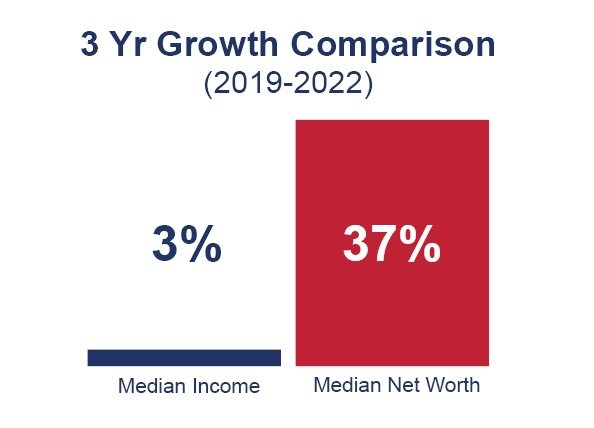
Between 2019 and 2022, the Federal Reserve reported that real median family income increased just 3 percent, while real median net worth increased 37 percent.
During that same period, only 14 percent of families in the bottom half of the income distribution owned a private business, compared with nearly half of families in the top decile.
Consider, we live in an economy where wealth can appreciate dramatically faster than wages, yet the opportunity to participate in that appreciation is distributed very unequally.
For most Americans, economic opportunity begins with getting a job.
Work hard. Build skills. Advance your career. Save for retirement. Perhaps buy a home.
There is nothing inherently wrong with that pathway. Work is valuable, and productive employment is essential to healthy communities.
But wages are compensation for labor. Ownership is a claim on the value that labor, knowledge, capital, and productive systems create.
An employee earns income by contributing to a business. An entrepreneur can create income while building an asset that may continue generating value beyond their individual labor.
Customers. Intellectual property. Processes. Equipment. Brand. Relationships. The institutional knowledge of how to create and deliver something valuable.
These are the building blocks of productive wealth.
And unlike wages, the value of ownership can compound.
We have designed a system where the people who already own assets have more opportunities to accumulate them, while those who depend primarily on wages must continually exchange their time to participate.
That is the architecture of economic inequality.
We see the price of admission everyday.
For nearly fifteen years, I’ve worked with founders in communities that rarely appear on national maps of venture capital and innovation.
I’ve met entrepreneurs who bring their children to workshops because they cannot afford childcare. People who leave their jobs to pursue businesses they believe in. Others who work all day, care for their families, and spend their evenings trying to build something that might give them a different future.
I’ve also watched founders do nearly everything we ask of them and still struggle.
They interview customers. Validate their assumptions. Develop financial projections. Build products and find their first customers.
And then they run out of money.
Sometimes their businesses fail because the market simply doesn’t want what they are offering. That is a legitimate risk of entrepreneurship, and no amount of public intervention can eliminate it.
But far too often, the business never gets a meaningful chance to prove itself because its founder cannot afford the transition from employment to ownership.
The financial system reinforces this.
Banks want collateral, credit history, and evidence of established cash flow. Investors often want exceptional growth potential, established relationships, and the possibility of extraordinary returns.
Those requirements serve their respective financial models. But they also leave an enormous gap between someone who is prepared to start a viable business and someone who can actually finance one.
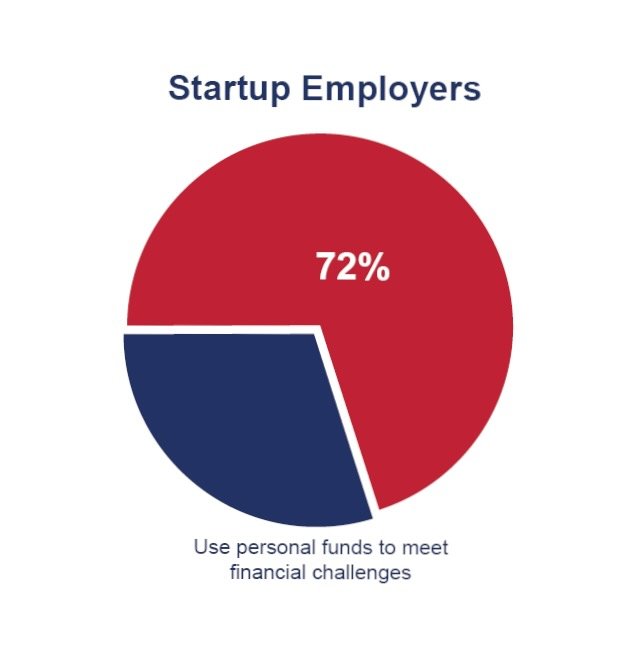
The Federal Reserve reports that 72 percent of startup employers use personal funds to address financial challenges.
That has real implications.
If starting a business requires personal wealth, and business ownership is a primary mechanism for building wealth, then what exactly are we telling people who have neither?
We’re telling them they must already possess some of the rewards of entrepreneurship before they can afford to attempt it.
And when the business fails, the consequences can extend beyond the founder. Savings disappear. Homes are put at risk. Families absorb debts that can take years to repay.
I’ve seen the persistence in a founder’s eyes when I know they aren’t going to quit, regardless of what I tell them.
Our job shouldn’t be to extinguish that ambition because the system is unforgiving.
Our job should be to build systems where a failed business doesn’t have to become a generational financial setback.
We Are Designing for the Wrong Outcome
This contradiction extends into the institutions responsible for economic development.
We invest enormous resources in preparing people for employment. We have occupational classifications, industry certifications, federally funded workforce training, apprenticeships, and performance systems that measure whether participants secure jobs.
Yet entrepreneurship remains an exception.
Federal law authorizes entrepreneurial training, but workforce performance measures still rely heavily on wage records that do not capture self-employment.
Someone can complete training, launch a business, generate revenue, and still appear unsuccessful within the system designed to measure their economic progress.
Imagine the absurdity of a city investing millions to attract a company that promises to create a hundred jobs, while struggling to justify a comparable investment in preparing a hundred residents to create businesses of their own.
We don’t have to imagine it. That is the system most of us operate within.
We learned how to measure the value of a job created by someone else.
Why have we been so reluctant to measure the value of an individual creating their own?
Perhaps because our measures of economic progress have been built around institutions rather than people.
We celebrate capital investment, payroll growth, and corporate recruitment. We track the expansion of industries and the relocation of employers.
But how often do we measure the number of people in a community who have gained a meaningful ownership stake in its productive economy?
How many workers have become owners? How many families have developed assets capable of creating intergenerational wealth? How many locally owned businesses have become pillars of their community?
Those outcomes should matter just as much as the number of jobs we attract.
Designing Economic Democracy
Economic inequality can’t be addressed simply by asking wealthy people to be more generous, or by redistributing a greater share of the wealth our existing systems produce. We also need to change who has the opportunity to produce and own that wealth in the first place.
That means treating entrepreneurship as a legitimate career pathway.
It means recognizing the skills required to build a business, making those skills accessible through publicly supported training, and providing meaningful ways for founders to demonstrate their readiness.
It means building financial instruments that recognize entrepreneurial preparation and verified business progress, instead of relying almost exclusively on a person’s existing assets.
And it means empowering the local institutions closest to entrepreneurs to play a greater role in helping capital reach the businesses their communities need.
These ideas are at the heart of our new Make Startups Institute report, Entrepreneurship is a Career Pathway.
The report calls for changes to federal workforce policy, entrepreneurship credentialing, income support during business formation, and the regulatory systems governing early-stage capital.
These are architectural interventions.
They don’t guarantee that every entrepreneur will succeed. They change the conditions under which people get the opportunity to try.
If we believe in freedom and democracy, that distinction matters.
Because the purpose of economic democracy isn’t to guarantee everyone the same outcome. It’s to create an economy in which more people have genuine agency over their future.
Who Gets to Design the Future?
I often wonder what our communities would look like if we organized economic development around the wealth and ownership capacity of the people who live there.
What if the success of a community wasn’t measured primarily by how effectively it attracted outside capital, but by how effectively it developed the productive capacity and ownership of its own residents?
What if our economic development institutions saw themselves as stewards of a locally owned economy, rather than simply intermediaries competing for the next corporate investment?
And what if our foundations, banks, and investors viewed the creation of new business owners as an investment in the long-term resilience of our democracy?
Those questions are particularly radical.
But answering them requires us to challenge assumptions that have become so embedded in our economic institutions that we rarely notice them anymore.
An architect learns that a building can be beautifully constructed and still fundamentally fail the people it was intended to serve.
Our economy is capable of creating extraordinary wealth. That doesn’t necessarily mean it is well designed.
The systems we inherit are not laws of nature. They are the accumulated decisions of people, institutions, and generations that came before us.
They can be redesigned.
For those of us who have spent our careers building entrepreneurship ecosystems, that should be both an invitation and a responsibility.
We’ve spent years helping individuals navigate systems that weren’t built for them.
Perhaps it’s time we stopped simply helping people find their way through those systems and started changing the architecture itself.
If we want an economy that works for more people, we have to give more people the power to own a piece of it.
That’s a future worth designing.
#BeTheNode #EconomicFreedom
Explore the research and policy recommendations in Make Startups Institute’s Entrepreneurship is a Career Pathway.
For research, policy, and philanthropic partnerships, contact partner@makestartups.org.