
Entrepreneurship is a Career Pathway
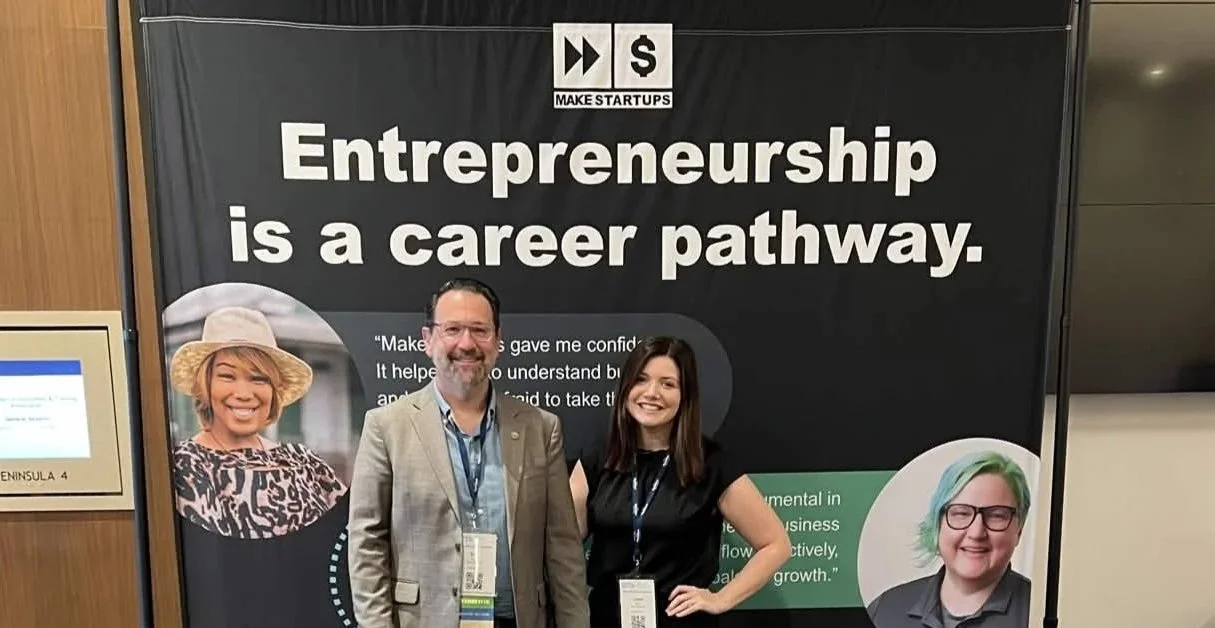
It’s easy to get caught up in capital stacks, pitch decks, and economic impact reports.
But every time we talk about how “startups are different,” we accidentally weaken the most effective argument our field can make:
Entrepreneurship is employment.
The common definition of an entrepreneur is someone “who makes money by starting or running a business.”
But a more useful definition is this:
An entrepreneur is someone who has chosen self-reliance outside of traditional employment pathways.
They might run a software company, a consulting firm, or an Etsy shop. The common thread isn’t industry. It’s that they’re building a career as self-employed, often becoming their own first employee.
And in a labor market being reshaped by AI, automation, and constant restructuring, a fair question is:
Are entrepreneurial skills becoming some of the most important workforce skills we can teach?
When we accepted the challenge to align entrepreneur support and workforce development back in 2019, we ran straight into real barriers, both structural and cultural:
Entrepreneur training lacked widely shared credentialing standards
Program revenue models were built around grant cycles, not workforce-fundable tuition models
Success was measured in “touchpoints” and capital raised, not skills growth and financial performance in the form of employment and wages.
Entrepreneurship wasn’t viewed as a reliable path to employment.
And worst of all, our field often reinforced a harmful belief:
Founders should defer compensation to “invest in the business.”
I’m sorry, but the myth of entrepreneurial self-sacrifice has done real damage; to entrepreneurs and to our field.
When people don’t build a plan to pay themselves, they disconnect from the most motivating factor there is: survival.
When you build a career outside the “system,” you become your own safety net. You have a runway that no amount of encouragement can extend.
Which is why the first thing most entrepreneurs need is not a pitch deck.
It’s a customer.
Here’s the simple reality we heard again and again when we talked with lenders and investors while developing training and assessment standards:
Capital follows cash flow. Cash flow follows customers.
Want a loan? You can’t service debt without customer revenue.
Want Venture Capital? Most SEED funding requires $500K - $1M ARR in today’s market.
Unless we’re talking deep tech commercialization, hard science, or heavy CapEx requirements, most businesses start the same way:
Customers and contracts first.
So what happens when we stop romanticizing founder struggle and focus entrepreneur training on revenue-building?
Founders grow revenue.
(And if we measure skills gained + earnings outcomes, workforce can fund it with confidence—not vibes.)
Five years of program performance data and founder stories keep pointing to the same lesson:
Entrepreneurship can be a measurable, fundable career pathway…if we treat it like one.
As we step into this new world, I keep coming back to a few core principles:
1. Entrepreneurship IS a Career Pathway
If we can measure skills gained and earnings produced, entrepreneurship becomes fundable, not theoretical. Make Startups graduates have a 63% employment rate 6 months after graduation. (compared to 57% for all workforce training programs)
2. Entrepreneurship is a HIGH-DEMAND career, why?
Virtually all net new jobs are from businesses less than 5 years old; ie. any community not investing in entrepreneur development will lag over time.
Entrepreneurship is also one of the few viable pathways for people who face real barriers inside traditional employment:
justice-involved
recovery populations
people with disabilities
dislocated workers / layoffs
And as AI accelerates occupational shifts, resilience starts looking a lot like agency.
3. Workforce funding can support entrepreneurs using existing “barrier-to-employment” logic
Workforce systems already know how to prioritize people based on income status, dislocation, disability, and other documented barriers.
Entrepreneurship belongs in that toolkit—especially for:
rural and persistent poverty communities
people experiencing layoffs
Re-entry
Disability
veterans / transitioning service members (where applicable)
While these numbers fluctuate with unemployment rates, approximately 20% of America’s entrepreneurs meet eligibility requirements for workforce assistance programs.
4. The best entrepreneur training is customized work-based learning
When learning, launching, and operating happen together, founders aren’t just “in a class.” They’re building employability through real work, under real constraints, with real outcomes.
Our world is rapidly changing. The systems that got us here are no longer reliable.
Entrepreneurship is the way we prepare a society to navigate this transition with agency and dignity.
Entrepreneurship isn’t just a career pathway.
It may be the most important workforce strategy to meet this moment in time.
#BeTheNode
Curious how many entrepreneurs in your own community may be operating under economic constraint? We built a Poverty & Opportunity Calculator to help ecosystem builders understand how poverty intersects with entrepreneurship locally.
Explore it here: https://www.makestartups.org/poverty-and-opportunity