
Executive Summary
The full report is available on CofounderOS.
It is easy to look back and convince ourselves that where we are today is exactly where we were always meant to be. Entrepreneurship did not begin in the modern West, but it undeniably flourished in traditions that elevated individual freedom, the pursuit of knowledge, and a commitment to the rights of others. Today, our world is steeped in polarization and incivility, driven in part by decades of declining economic mobility, weakened community health, and a broader reordering of global economics and power.
While this change stems from multiple forces, it has also coincided with a decades-long decline in entrepreneurship in America. For many, the market collapse of 2008 and the Great Recession marked a turning point. Out of that era, entrepreneur support moved beyond being primarily limited to university incubation programs and Small Business Development Centers. We shifted toward independent grassroots incubators, coworking spaces, makerspaces, venture-backed accelerator programs, growing angel networks, and emerging venture funds.
Researchers deepened the case for why this mattered, most notably identifying new businesses as responsible for virtually all net new job creation (Decker et al. 2014), and showing that startups are disproportionately responsible for the innovations that drive productivity and economic growth (U.S. Census Bureau 2017).
Organizations like Startup America, the Kauffman Foundation, and others connected and invested in these localized efforts, helping coalesce grassroots activity into an ecosystem-building movement. As these efforts gained notice, the federal government stepped in as well, helping turn what began as local social entrepreneurs figuring out business models to support other entrepreneurs into a recognized field, with billions in public funding eventually flowing into the work.
And yet today, that flood of money, while not gone, has become far less reliable.
Between administrative cuts and legislative stalemates, key programs and appropriations have been eliminated, scaled back, or delayed. Many continue to operate under uncertainty, at risk of expiring year to year. Whether out of fear of political repercussions or a desire to chase the next new initiative, foundations have pulled back. Investors have stepped back as well, with even seed rounds increasingly expecting meaningful traction and revenue. For many organizations, Make Startups included, these converging forces have created real financial strain.
And yet, these headwinds may be exactly what we need to get back to the one thing we are actually supposed to do right.
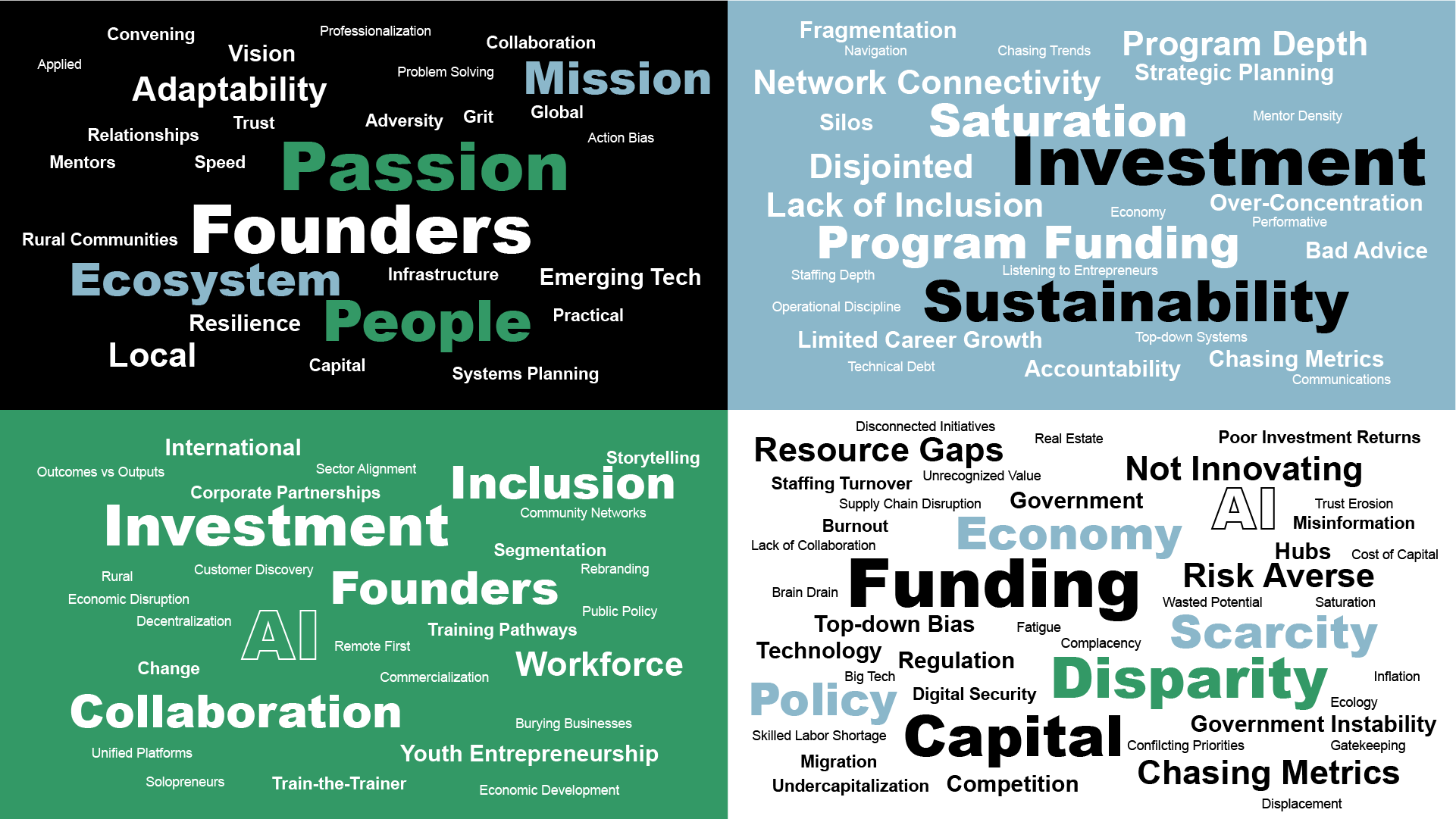
The clearest thread running through our industry SWOT analysis is this:
Our job is listening to entrepreneurs.
When we fail to do that, it shows up as a weakness. When we chase metrics in service of funders instead of outcomes in service of founders, it becomes a threat. And when founders and investors no longer see the ROI in showing up for startup theater designed to satisfy grant objectives instead of founder needs, we should not be surprised when trust erodes.
At the same time, the SWOT does not describe a field without strengths. It points to resilient founders, committed ecosystem builders, growing collaboration, and new tools, especially AI, that can lower the cost of experimentation and expand how we deliver support. The issue is not that the field lacks potential. It is that too often we organize around our institutions instead of around the actual needs of entrepreneurs.
For too long, many in our field have chased short-term windfalls. We have played the game and counted activity instead of progress. Yes, we care about our founders. But increasingly, founders and investors alike have struggled to find the ROI for their time and energy in systems that reward visibility, programming volume, and institutional comfort over traction, clarity, and real support.
So while we acknowledge the discomfort our field feels as funds dry up, this may ultimately be good for founders and good for us. When you drill all the way down to the basics, our job is to help people make money in pursuit of their dreams. By steering our organizations back toward the needs of founders, we can stop chasing metrics for their own sake and start innovating around values-aligned revenue models that can withstand broader institutional instability. It is on us to be as entrepreneurial as the people we serve.
Our greatest opportunities are clear:
AI, as both a catalyst for startups and a tool that can transform how we deliver services
Investment capital, as more ESOs adopt funding strategies of their own to address capital scarcity
Founders, as the most important renewable resource we nurture
Collaboration, as our field matures and more ESOs work together to build regional and industry ecosystems while sharing knowledge and best practices
Inclusion, because how we remove barriers remains one of the clearest opportunities to transform communities from persistent poverty to economic mobility
Workforce, as we better link entrepreneurship to career pathways, unlock new resources, and shift education systems to prepare people for greater self-reliance
That is what this report is about. It is not just a snapshot of our field. It is a call to sharpen it. Read it with your team. Use it to examine what you measure, how you collaborate, how you fund your work, and whether founders would say they are genuinely better off because you exist.
Our field is centered on these principles:
Self-reliance over systems dependence
Resilience through collaboration
An embrace of strategic risk-taking
Long-term investment over short-term exploitation
And ultimately, building sustainable revenue models
Because if we cannot figure out how to build sustainable ways of helping people make money, then we have no business calling ourselves ecosystem builders.